"Systems permit ordinary people to achieve extraordinary results predictably." : Michael E. Gerber
It’s Friday afternoon. For many business owners, this is the time of week when the "running on fumes" feeling sets in. You’ve put in sixty hours, made a thousand micro-decisions, and your brain feels like a browser with too many tabs open.
If you’re feeling burned out, your first instinct might be to question your motivation. You might think you need a vacation, a pep talk, or a fresh burst of entrepreneurial "hustle."
That’s rarely true.
If you’ve already built a million-dollar business, motivation isn't your problem. You wouldn't have reached this level without an extraordinary amount of it. The wall you’re hitting isn't a lack of desire; it’s a lack of structure.
You don't have a motivation problem. You have a systems problem.
The Myth that Burning Out Means You Aren't Working Hard Enough
In the early days of a business, heroic effort is a requirement. You are the sales department, the delivery team, and the janitor. You win through sheer willpower.
But what gets you to $1 million is rarely what gets you to $5 million.
Many successful entrepreneurs believe that if they are stressed, they just need to "grind" through it. They assume that burning out is a sign that they aren't tough enough or that they've lost their edge.
In reality, burning out is often a sign of high-functioning inefficiency. You are working incredibly hard to keep a manual machine running. When you rely on personal effort rather than organizational systems, you aren't building an asset: you’re building a job that you can't quit.
Why Successful Entrepreneurs Hit the "Manual Wall"
When a business grows, complexity doesn't increase linearly; it increases exponentially. More customers mean more service tickets, more staff mean more management overhead, and more revenue means more financial risk.
If you are still managing the business using the same manual methods you used at $200k, you will eventually hit the "Manual Wall."
This is the point where your personal capacity is the primary bottleneck for the entire company. Every decision has to go through you. Every problem requires your specific "gut feeling" to solve.
This creates a business that is fragile. If you get sick, the growth stops. If you take a week off, the quality drops. At Shank Coaching, we see this most often with established owners who are tired of the "spend more to earn more" trap that kills profit margins.
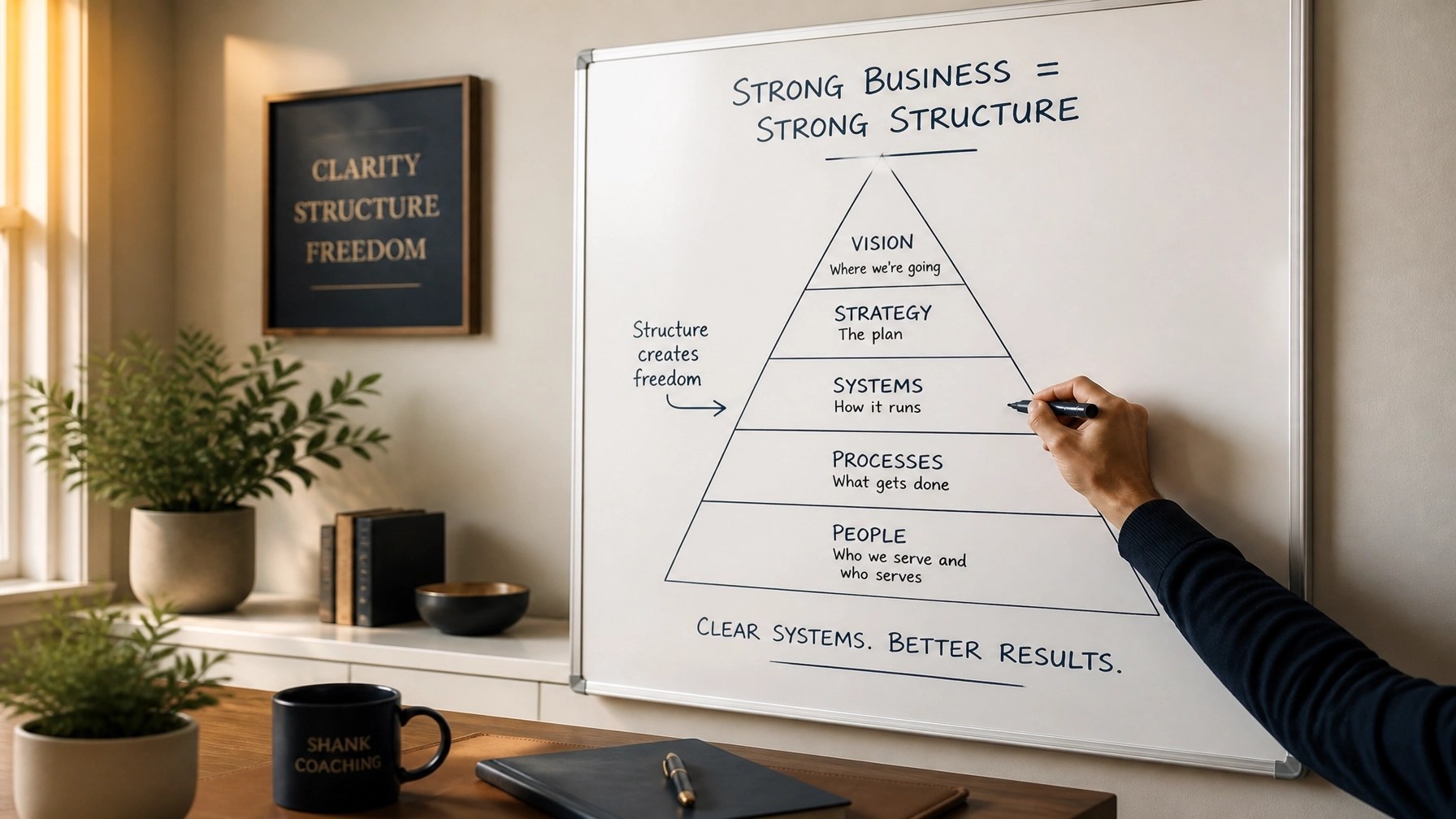
Systems Create Predictability, Not Just Efficiency
Most people think of systems as boring documents or restrictive rules that kill creativity. They view systemization as a way to "save a few minutes" on a task.
That’s a narrow view.
The real value of a system is predictability.
A system is a documented, repeatable process that produces a consistent result. When you have a system for Lead Generation, you know exactly where your next customer is coming from. When you have a system for your Closing Rate, you know exactly what your revenue will look like next month.
Systems turn a "stressful week" into a "manageable one" because they remove the unknown. You aren't guessing if things will get done; you are monitoring the machine that does them.
Accountability: The Missing Piece Most People Skip
A system on a piece of paper is just a suggestion. It only becomes a tool for growth when it is combined with accountability.
Accountability is the bridge between having a process and getting a result. It’s what ensures the systems are actually used, measured, and refined.
For the $1M+ business owner, accountability often means two things:
- Team Accountability: Ensuring your staff is following the standards you’ve set.
- Founder Accountability: Ensuring you are staying in your "Zone of Genius" and not diving back into the day-to-day firefighting that ruins the system.
Predictability comes from the system; performance comes from the accountability. Together, they give you the freedom to scale intelligently.
The Difference Between Being Busy and Being Productive
It is very easy to be busy for twelve hours a day while moving the needle zero inches. We call this "active inertia."
It’s the act of doing things that feel like work: checking emails, attending unnecessary meetings, or tweaking marketing copy: instead of doing the high-leverage work that drives profit.
Productivity in a million-dollar business isn't about doing more tasks. it's about optimizing the Pathway to Profit system.
If you spend your day solving a recurring problem that should have been fixed by a system six months ago, you are being busy, not productive. You are essentially paying yourself a founder’s salary to do a technician’s job.
A Practical Framework: What Needs a System First?
When business owners realize they need systems, they often get overwhelmed and try to document everything at once. This usually leads to a pile of manuals that no one reads.
Instead, you should focus on the areas that have the highest impact on your net profit. At Shank Coaching, we use the Pathway to Profit system, which focuses on eight strategic areas.
If you aren't sure where to start, analyze these three areas first:
- Lead Generation & Conversion: Do you have a repeatable way to find prospects and turn them into leads without you personally "hustling" for every name?
- Closing Rate: Is your sales process documented so that someone other than you can close a deal with the same effectiveness?
- Retention & Frequency: Do you have a system that automatically stays in touch with your existing database to generate new business?
One client I worked with increased their profit by 56% in a single year just by focusing on these optimizations. We didn't increase their marketing spend by a single dollar. We simply systematized the "leaks" in their existing bucket.

Moving Beyond the "Fumes"
If you are running on fumes this Friday, don't look for more motivation. Look for the gap in your structure.
The goal isn't to work more hours. The goal is to build a business that produces 100% to 300% revenue growth because the system is designed to do so, not because you are personally pushing it over the finish line.
Systems are what allow you to step away from the business without it falling apart. They are what turn a "proven concept" into a scalable enterprise.
If you’re tired of the "spend more to earn more" trap and you're ready to scale intelligently, it might be time to stop looking for more "hustle" and start looking for better systems.
If you need help tweaking your current processes or creating the systems that will actually let you scale, give Ron a call at Shank Coaching. He loves to talk about this stuff and can help you identify exactly where your revenue is being left on the table.
Visit shankcoaching.com to learn more about the Pathway to Profit system and how we help business owners find hidden revenue in their existing operations.